
NOCoE strategic goals
NOCoE Strategic Advisory Council (Council) met in February 2020 to set the strategic direction expressed in this NOCoE 2021–2025 Strategic Plan. NOCoE’s first strategic plan, developed shortly after its inception to cover the period of 2016–2019, ably guided NOCoE to execute its mission, and the plan’s goals and objectives guided NOCoE’s services and products to effectively serve the TSMO community.
To identify any new strategic direction for NOCoE, the Council considered the progress TSMO has made as an institution, program, and practice among transportation organizations, as well as how industry trends and the needs of the TSMO community have evolved since NOCoE’s inception. The Council updated the Vision and Mission of the organization and devised a new set of strategic goals and objectives to leverage the good work of NOCoE to date and to continue to advance the services and programs for the TSMO community.
Equity and Access
Transportation equity, the concept of fairly distributing the costs and benefits of transportation services, is an important idea for both system users and system operators, while the concept of basic access to essential goods, services, and activities (e.g. food, health care, or employment) is inherent in NOCoE’s vision of a transportation system that works to save lives, time, and money.
As part of the Strategic Plan, NOCoE will consider the incorporation of transportation equity and providing basic access to everyone as it develops resources and tools for the TSMO community. NOCoE will also ensure its activities and services are aligned with AASHTO, ITE, ITS America, and FHWA's ongoing leadership in these areas.
VISION
NOCoE’s exceptional services to the transportation systems management and operations community saves lives, improves travel times, and enhances economic vitality.
MISSION
NOCoE provides centralized services to support the transportation industry through workforce readiness, deployment of technology and practices, and mainstreaming of TSMO solutions through education, networking, communication, and knowledge transfer.
Strategic Goal #1: Attract, Develop, Sustain, and Expand the TSMO Workforce
- Increase the knowledge and capabilities of the TSMO workforce along their career paths, from students to executives
- Articulate an inclusive and understandable approach to TSMO (e.g. urban, rural, large, small agency TSMO practices)
- Leverage all available resources (e.g. partner agencies, universities, federal, private sector) to expand the reach of workforce development
- Broaden workforce development to TSMO paraprofessionals, other agency disciplines (e.g. planning, design, etc.), local agencies, etc.
- Facilitate connections among members of the TSMO workforce to learn from one another
Strategic Goal #2: Accelerate Deployment of Current and Emerging TSMO Practices (Technology and Strategies)
- Monitor, synthesize, and share TSMO best practices, lessons learned, and deployment activities
Examples of potential activities include, but not limited to:- Synthesize and highlight emerging trends
- Identify topical needs or gaps in deployment and practices
- Provide and facilitate forums for exchanges on TSMO experiences and challenges
- Provide a real-time or on-demand platform to respond to user requests
Strategic Goal #3: Mainstream TSMO as a Core Function of Providing Transportation System Solutions for All
- Use knowledge management and strategic communication processes
- Empower and support champions
- Continue demonstrating the benefits and value of TSMO
- Highlight and demonstrate the path for agencies to mainstream TSMO
The Council discussed the following activity to be included, but not limited to:- Applying available tools such as capability maturity model resources
- Demonstrate value to broaden technical services’ reach to include other audiences (e.g. local agencies, MPOs, etc.)
IMPACT ON OUR INDUSTRY
This new strategic plan will effectively guide NOCoE on how best to empower the TSMO community in their effort to improve the transportation system. The focus of mainstreaming TSMO and improving the workforce, in combination with providing resources, will allow TSMO strategies to become a core function of transportation solutions.
TSMO Workforce Development
Growing and developing the TSMO workforce requires a variety of approaches and strategies, from educating students on TSMO careers to increasing the skills of the current workforce.
The guidebook was transformed from a PDF to a suite of webpages that consists of TSMO workforce resources to aid you in developing your TSMO workforce. The suite of webpages and resources can be found here.
Guidebook
The intent of this guidebook is to provide practitioners with a tool to develop a strong Transportation Systems Management and Operations (TSMO) workforce. While a basic understanding of TSMO is beneficial to the reader, this guidebook focuses on workforce development practices rather than the specific details of TSMO, so readers without a background in TSMO will find the information within useful.
This guidebook goes into detail on the hiring and workforce development practices recommended through literature and currently in place within existing and successful TSMO programs. It clearly identifies specific job positions required for a robust TSMO program, the knowledge, skills, and abilities required for those job positions, and recommendations tailored to hiring each position. Information on training and professional development is presented, including specifics on training providers and courses.
Several agencies have faced challenges redefining or creating position descriptions for a contemporary TSMO workforce. The scope of the work was limited to positions that require a 4-year college degree and above. There are future opportunities to apply similar methods for assessing needs for other, para-professional positions such as TMC Operators, electrical technicians, and freeway service patrol drivers.
The position descriptions compiled by the team include:
- jobs that are currently being filled by organizations in varying degrees as they shift towards more comprehensive TSMO throughout the organization; and
- jobs that will be required in the next 5 to 10 years depending on how rapidly emerging technology makes its way into the transportation industry. While many of the position descriptions build on more specialized civil engineering skills, others recognize the need to broadly expand and diversify the training and education needed for future positions.
The 19 positions descriptions are provided via the links below. Each example position description is organized in a table format and includes the components shown in the figure below
- Traffic Data Scientist/Statistician
- TSMO Manager/Chief/Bureau Director
- TSMO Program Manager
- Computer Engineer
- Artificial Intelligence Scientist
- Telecommunications Engineer
- Data Management Specialist
- Visualization Specialist
- Connected and Automated Vehicles (CAV) Program Manager
- Traffic Incident Management (TIM) Program Manager
Workforce development case studies
- Maryland - Organizational Modernization To Advance TSMO
- Tennessee - TDOT Regional Operations Forums
- Washington - A Workforce Shift Toward TSMO
- Ohio - Workforce Development with Ohio TSMO Coordinators
NOCoE Summit – Funding and TSMO in Capital Infrastructure Projects
On August 7-8, 2019, the National Operations Center of Excellence convened a group of transportation systems management and operations (TSMO) practitioners from state, regional and local transportation agencies to discuss major practices around funding and planning for TSMO within their transportation departments. The two goals of the 2019 NOCoE TSMO Summit on Funding and Capital Improvement Process Integration were to:
- Identify the current practices for funding of TSMO.
- Identify current practices, along with research and resource needs, for integrating TSMO into the capital improvement process.
This report not only encapsulates the findings of the summit, discovered thanks to the contributions of specific agencies that prepared materials and participated, but also provides details on how TSMO is currently deployed in a variety of transportation agencies. The in-depth discussion that captured specific best practices also identified gaps in how TSMO is deployed and funded inside transportation agency processes. Practitioners also identified a number of research and resource needs to efficiently advance the adoption of TSMO.
It is possible to correlate the efficacy and sustainability of the adoption of TSMO as a mainstream practice within the transportation system community with integrating TSMO into the capital improvement process. The Summit Report looks at each step of the capital improvement process to extract lessons learned and positive and encouraging policies and procedures. It also identifies areas the TSMO industry can focus on.
TSMO Funding Fact sheets
A key component of the summit was the ability to capture key facts and successful practices by DOTs in their efforts to incorporate TSMO in the capital improvement process and to fund TSMO. As a follow up to the summit, NOCoE has created TSMO Funding Fact Sheets for several agencies who participated in the event, to attempt to transfer knowledge to other TSMO programs and transportation agencies on how best
TSMO Case studies
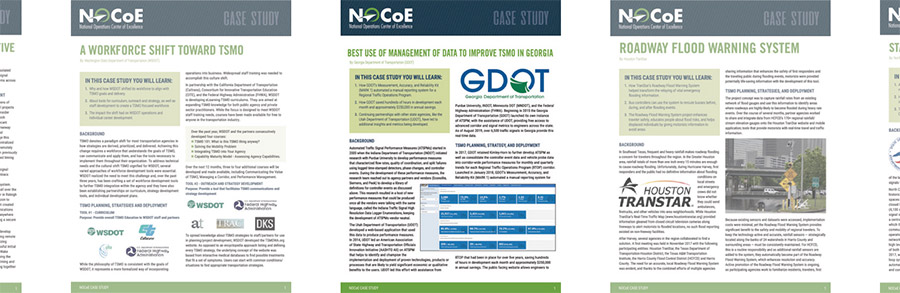
There are now over 100 NOCoE Case Studies available, built from a variety of sources, including TSMO award submissions and academic and DOT collaborations. The range of case studies topics has increased in 2020, with the addition of case studies focused on data management and workforce as well as an additional set of case studies on how DOTs are collaborating with local universities and colleges.
CASE STUDY METRICS:
- 102 NOCoE Case Studies since August 2018
- 9,000+ case study views in 2020 (up 16% from 2019)
- 42 organizations have served as authors
IMPACT ON OUR INDUSTRY
NOCoE Case Studies continue to be the most widely viewed resource on the NOCoE website and are utilized by the TSMO community for collaboration, interagency discussion, and the application of new strategies.